

Growth of the Civil CUAS Sector
A Threat that has Moved Far Beyond the Battlefield
With the war in Ukraine entering its fifth year, as well as other heightened geopolitical activities around the world, it is entirely understandable that awareness of drones has largely focused on war zones and military conflicts. However, the rapid pace of technology and proliferation of these unmanned aerial vehicles (UAVs) means the need for counter-drone measures goes far beyond the trenches. If small drones can disrupt complex, large-scale military theatres with relative ease, they can also unsettle far less protected civilian airspace, critical infrastructure and the general rhythm of everyday civilian life.
A Market Entering its Acceleration Phase
In addition to possible weaponization, UAVs are highly accurate forms of surveillance and unmanned delivery which has exposed gaps in security systems and introducing the additional threats to civilian domains. Governments, law enforcement agencies, critical infrastructure operators, transport authorities and major event venues are all confronting risks that were not at the forefront a decade ago. This underpins the ever-growing demand and use cases for counter-unmanned systems (CUxS) to civilian markets, which is being targeted by DroneShield.
The total addressable market for counter-drone technologies has been estimated at US$63 billion[1]. While 56 per cent was tied to military, government and law enforcement customers, the faster growing segment is the 44 per cent (US$28.2 billion) addressing the civilian market. This is driven by regulation, risk mitigation and public safety requirements, with a particular focus on the protection of assets.
It is DroneShield’s experience that civilian customers are rapidly playing catch up, with a recognition of this amongst both policymakers and end-user customers. The market segments of civilian critical infrastructure needing CUxS are set out below.
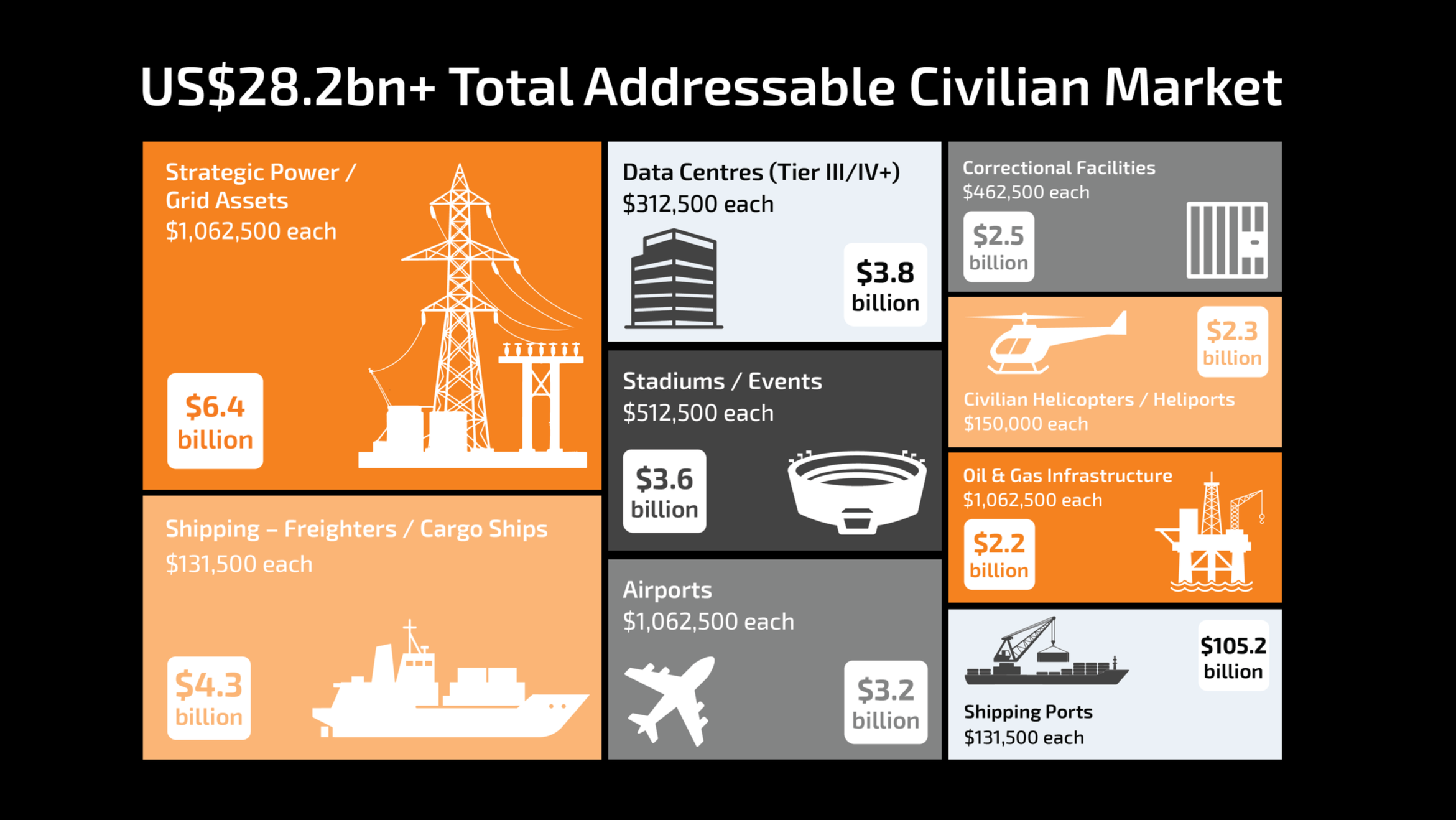
Image: Total Addressable Civilian Market, 2025 Total Addressable Market (TAM) Report for Counter-Uncrewed Systems
Regulation is Catching Up and Expanding the Market
In order to thoroughly unlock the US$28.2 billion market, there is mounting evidence that civilian operators need, and are being given, clear legal authority to detect, track or mitigate against drones.
In the United States, the Safer Skies Act was passed in December 2025 which set out measures for state, local, and territorial law enforcement and correctional agencies to address the threat of unauthorized drones and the credible threats posed to public safety and critical infrastructure from UAVs. This includes federal funding for technology and training to detect and track drones, identify operators, and disrupt or disable them if a credible threat is determined. The Act’s inclusion in the FY2026 National Defense Authorization Act marks the first significant expansion of domestic counter‑drone authority since 2018. Under this framework, qualified law enforcement, airports and critical infrastructure operators will be able to detect, track and when necessary, defeat unauthorized drones using approved technologies[2]. The Trump Administration has labeled restoring American airspace sovereignty as a top priority[3].
Parallel reforms are underway internationally. In Europe, the European Union Aviation Safety Agency’s U-space Regulation and Counter‑UAS Action Plan have established standardized airspace management and incident response requirements for airports and authorities.
Several Asia-Pacific regulators are conducting similar reviews, aiming to give local law enforcement, aviation agencies and critical infrastructure operators authority to detect and respond to unauthorized drones.
Airports
In December 2018 during the days leading up to Christmas, flights at London Gatwick Airport were grounded to a halt. For more than 30 hours over three days, in excess of 1,000 flights were canceled and around 140,000 people were impacted at the UK's second biggest airport following drone sightings[4]. This cost to the airport alone was £1.4 million and prompted an investment of £4 million in counter-drone technology[5]. This does not include the accumulated costs, delays and flow-on inconvenience to airlines, passengers and other associated stakeholders. Since Gatwick, drone incursions at airports have surged. Between January 2024 and November 2025 alone, drone-related disruptions at European airports quadrupled[6].
DroneShield estimates global demand of US$3.2 billion in CUxS across over 3,000 large-scale airports which are high-risk sites for drone incursions. In order to meet this critical need, there has been a noticeable and rapid pace for regulatory mandates to accelerate adoption.
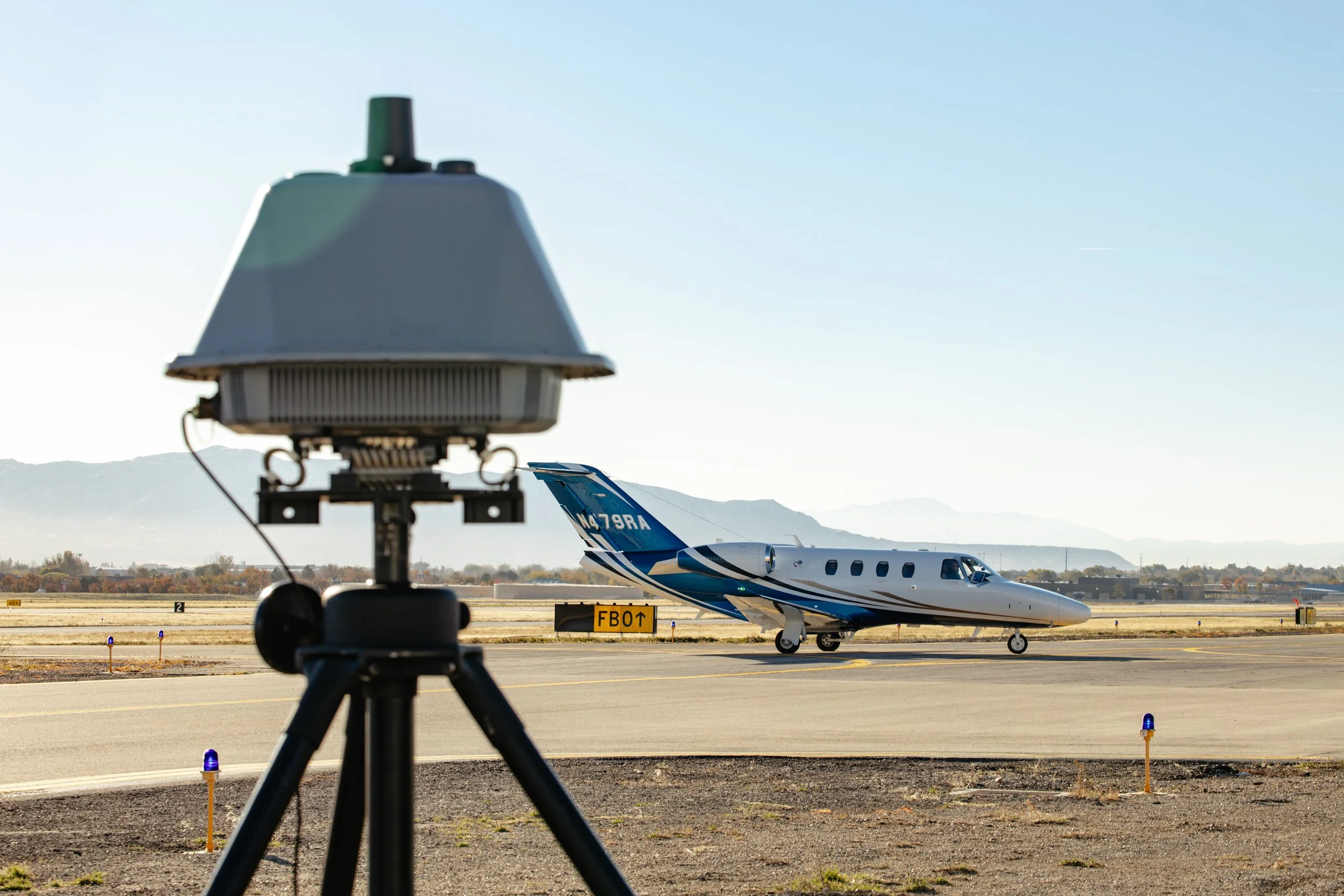
Image: DroneShield's DroneSentry-X Mk2
Energy Facilities
Russia's sustained attacks on Ukraine's energy and freight infrastructure carried out using drones and missiles, have caused widespread power outages across the country and left civilians without electricity during freezing temperatures[7]. These strikes serve as a real-time warning of how vulnerable critical infrastructure becomes when adversaries exploit the airspace close to it.
In November 2025, security teams at Belgium’s Doel nuclear power plant reported five drones flying over the site. Far from being an isolated event, a cluster of similar incursions prompted the United Kingdom, France and Germany to send personnel and equipment to help Belgium reinforce security around sensitive infrastructure[8].
The interference by a malicious drone at a power plant, refinery or substation can compromise the supply of heat, electricity and fuel that households and businesses depend on. Disruptions could be immediate and far reaching, and at their extreme could threaten the public order and sovereignty of a geography. Incidents like these signals a clear systemic shift and highlight how security strategies must address the ever-real threats from drones, just as they do with physical and cyber security. With an estimated 6,000 critical infrastructure nodes, including substations and nuclear facilities, there is a global market opportunity of US$6.4 billion for CUxS. There are a further 2,025 target locations with a market opportunity of US$2.2 billion when considering refineries, pipelines, offshore oil rigs, LNG terminals and strategic energy sites.
Large-Scale Public Venues
Stadiums, concert venues and major sporting events increasingly recognize airspace security as a core component of their risk management plans. In the United States the NFL recorded more than 2,000 drone incursions in each of the past three seasons[9]. The economic stakes are substantial: a single drone incursion can halt operations, disrupt broadcast schedules, trigger evacuations and expose operators to losses far exceeding the cost of preventative measures. With an estimated global market of approximately 7,000 venues, this represents a US$3.6 billion addressable market for DroneShield.
Event organizers are responding by integrating CUxS into their security planning and coordinating with local authorities to secure low‑altitude airspace. The upcoming 2026 FIFA World Cup, co-hosted by Canada, Mexico and the United States is expected to draw millions of spectators across multiple host cities. With this, and reinforced with the Safer Skies Act, to be able to rapidly deliver solutions that safeguard attendees and protect critical public infrastructure.
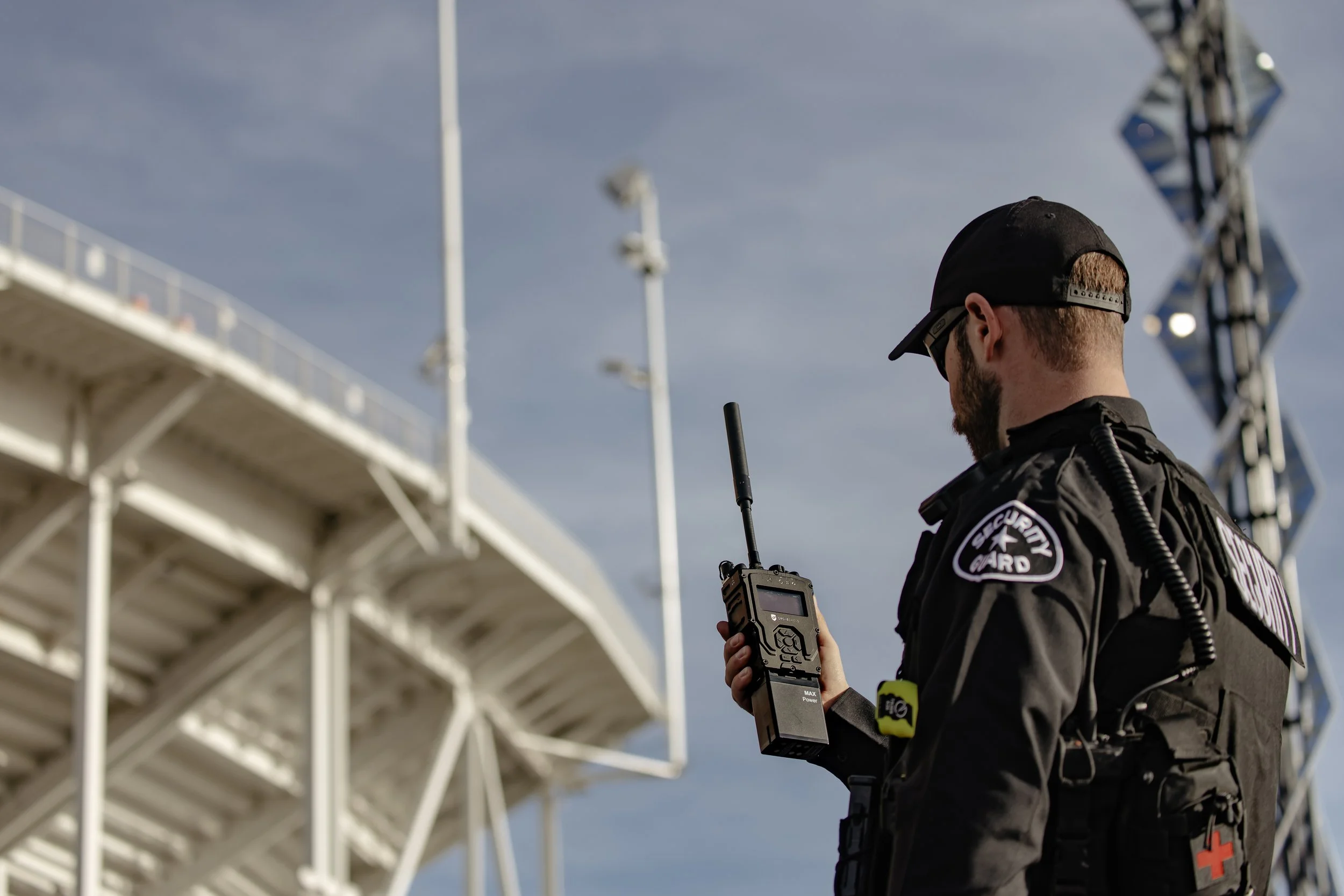
Image: DroneShield's RfPatrol MK2
Prisons, Correctional Facilities and Criminal Elements
Globally, drones have become a preferred tool for contraband drops at correctional facilities. Across England and Wales between April 2024 and March 2025, there were 1,712 drone incidents at prisons – a 43 per cent increase compared to the previous 12 months[10]. In Colombia, a country long plagued by guerrilla warfare, there were reportedly 8,000 drone-related attacks in 2025. The surge has prompted authorities to restrict drone imports via traditional postal channels[12]. Across Latin America, criminal organizations have expanded their use of drones beyond smuggling, incorporating them into surveillance, intimidation, and other illicit activities. With an estimated 9,000 global correctional facilities, there is a potential market of US$2.5 billion for DroneShield’s product offering.
A Multi‑Sector Growth Story
As an early pioneer in the field, DroneShield is recognized as the only pure-play counter-drone specialist globally, offering a tried and tested dependable capability, which has evolved from the battlefield and ready for effective deployment in civilian environments.
This maturity is driving a broader investment story. Demand now spans defense, government and commercial sectors, creating a diversified and resilient market. The threat environment is persistent and does not track economic cycles. Many of the most frequent and disruptive incursions occur in civilian settings, the civil market continues to expand and now represents a significant share of the total addressable market. For investors, this convergence of technological readiness, multi‑sector demand and long‑term threat drivers positions the counter‑drone sector as a durable growth opportunity.
[1] DroneShield – “2025 Total Addressable Market Report,” October 2025
[2] U.S. Congress. H.R. 2353 — Safer Skies Act of 2025. 119th Congress (2025–2026)
[3] U.S. Department of Homeland Security – “Department of Homeland Security Launches New Office to Advance Drone and Counter‑Drone Capabilities.” 12 January 2026
[4] Sky News – “Gatwick Airport forced to shut runway for almost an hour over suspected drone,” May 15, 2023
[5] The Guardian – “Gatwick drone disruption cost airport just £1.4m,” June 18, 2019
[6] Monocle – “How Europe’s airports must prepare for an increasingly drone‑prone 2026,” December 2025
[7] ABC News – “Russian drone, missile attacks target Ukrainian railways and power infrastructure in overnight barrage,” 6 December 2025
[8] Politico Europe – “Drones spotted over Belgium’s Doel nuclear plant spark security concerns,” 2025
[9] ESPN – “NFL seeing thousands of drone incursions each season, league says.” 11 December 2025
[10] Sky News – “Number of drone incidents in prisons rises by more than 40%, figures show.” 31 July 2025
[11] France24 – “Colombia restricts import of drones used in explosives attacks.” 29 January 2026